
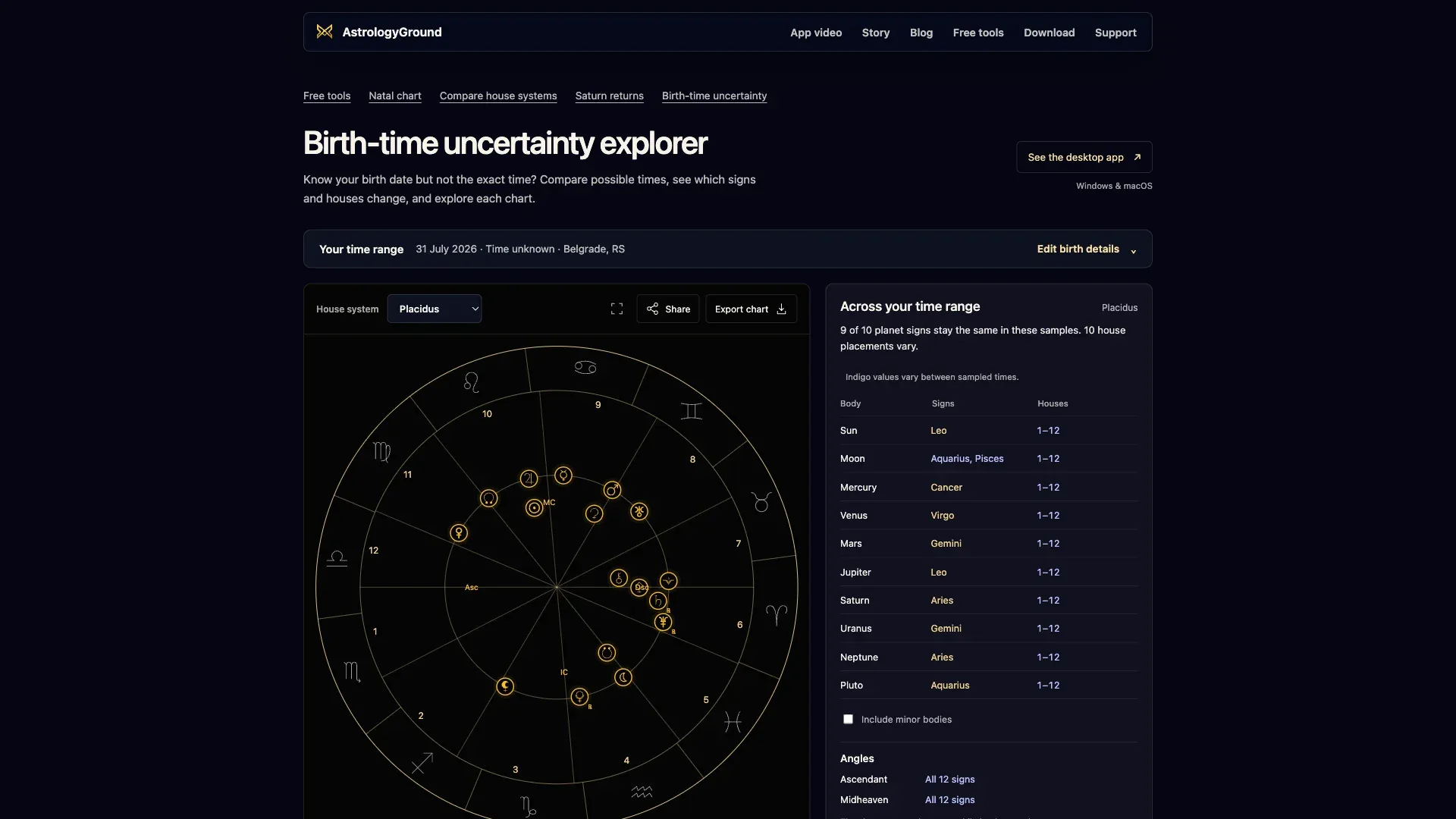
You can explore a birth chart without knowing your exact birth time. Many planet signs may stay the same throughout your birth date, giving you something useful to work with. Your rising sign, Midheaven and houses need more care: a chart drawn for an arbitrary time cannot establish those placements.
The useful first step is to compare the possible times. Our free birth-time uncertainty explorer shows which signs and houses stay the same across your range and which vary. You can start with a whole day if you have no time at all, or a narrower window if you have evidence for one.
What can you know without a birth time?
Start with the planets’ zodiac signs. If Venus remains in Virgo throughout the period in which you could have been born, Venus in Virgo is consistent with that entire range. Its exact degree can still change.
The Moon deserves particular attention because it moves through the zodiac faster than the other planets shown in a natal chart. It may occupy two signs within your possible birth times. Other bodies can cross a sign boundary too, including the Sun. In their discussion of charts without a birth time, astrologers Chris Brennan and Leisa Schaim explain why these boundaries matter.
Check the date rather than assuming your Moon sign is unknown or your Sun sign is certain. A full-day comparison can show that one sign remains possible, or that you need a better time range before choosing between signs.
Why a noon chart can be misleading
Noon is a common reference when the birth time is missing. For example, CHANI’s unknown-birth-time guidance suggests it as an option while acknowledging reduced precision.
That chart represents the sky at noon. A calculator may draw a rising sign and houses around it, but those belong to the placeholder time. They do not become your recorded birth placements because they appear on the wheel.
The Ascendant, or rising sign, is tied to the eastern horizon at the selected time and place. The Midheaven is another time-sensitive angle. Our guide to why birth time and location matter explains how those inputs define a chart.
Changing house systems does not supply the missing time. Even Whole Sign houses need a rising sign to identify the first house. See how astrology houses are calculated for the difference between the systems.
A full day can leave some signs clear and others open
We tested an illustrative date: 31 July 2026 in Belgrade, Serbia, using the Europe/Belgrade time zone. With the time unknown, the explorer compared the full local day in 1,440 one-minute samples. We selected Placidus houses.
Nine of the ten displayed planet signs stayed the same across those samples. Venus remained in Virgo, for example. The Moon appeared in both Aquarius and Pisces, so this date alone would not settle the Moon sign.
The houses told a different story. Each of the ten planets appeared in every house across the samples. The Ascendant and Midheaven each spanned all twelve signs.
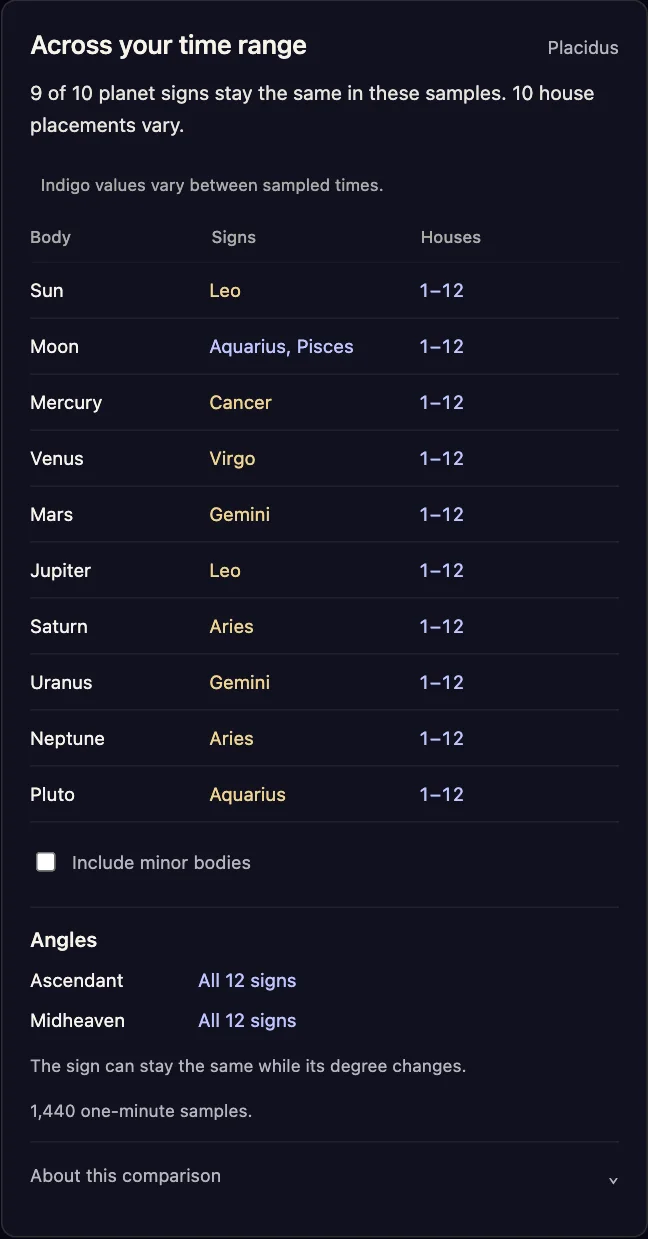
In this example, you can explore Venus in Virgo while leaving its house open. Another date or place can produce different results.
The one-minute samples also have a limit: they compare selected instants rather than every instant between them. They do not prove that a sign or house boundary falls at an exact minute.
What if you know roughly when you were born?
Use the narrowest range you can support. If a reliable record places the birth between 09:00 and 10:00, compare that hour. If a relative only remembers “morning”, keep the wording and its uncertainty rather than turning it into an exact time.
You may be able to find a time in available birth or hospital records, or ask someone who was present. Availability and detail vary. Keep track of whether a time came from a record, a recollection or a later estimate.
In the explorer, enter your birth date and birthplace, then choose the time range that matches what you know. Compare the summary first. Select individual times to see their charts, keeping each wheel labelled as a candidate.
A narrower range may leave fewer possible signs or houses. It can also leave a boundary unresolved. Neither result tells you which minute is most likely.
Are aspects still useful without an exact time?
Some planetary relationships can remain similar across a day, but a stable sign does not establish an exact degree. An aspect depends on the angular distance between bodies and the allowed orb. A changing degree can move an aspect into or out of that allowance, especially when the Moon is involved. Our guide to aspects and orbs explains the measurement.
The explorer’s aspect display belongs to the currently selected candidate chart. Its range summary compares signs and houses. Do not read that summary as a check that every displayed aspect holds throughout the day.
Can astrology recover a missing birth time?
Astrologers call the process of proposing a time from life events and astrological techniques rectification. In their introduction to rectification, Chris Brennan, Leisa Schaim and Patrick Watson describe its investigative nature and the difficulty of confirming it without a later-discovered birth time.
Keep a proposed time distinct from a recorded one. Recognising yourself in a rising-sign description does not establish when you were born. Our explorer compares possibilities. It does not perform rectification.
Start with the range you actually know
You do not need to settle every uncertain placement before exploring the signs that remain consistent. Keep your date, place and possible time range together, and revisit the comparison if better information turns up.
Compare your possible birth times, then use the summary to decide which parts of the chart you can explore with more confidence. Birth details and calculations stay in your browser. If you share a chart image, include its uncertainty so others can read it in context. Birth details stay off the image unless you choose to add them. Our website-tool privacy details explain local calculation, website analytics and files you choose to share.