
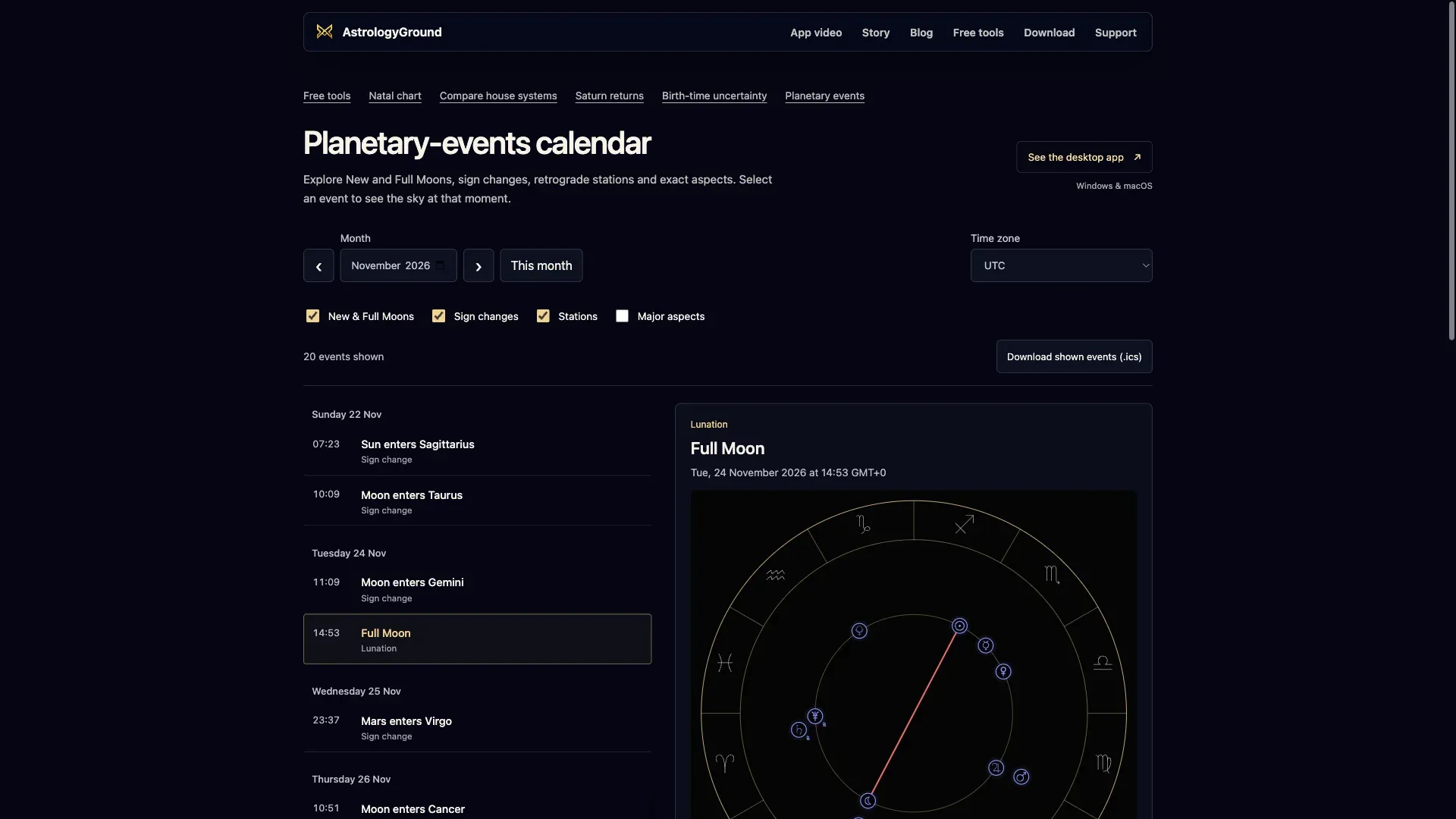
A planetary-events calendar marks New and Full Moons, planets entering zodiac signs, changes of direction, and exact aspects. Reading those entries helps you follow the month without having to inspect a chart for every hour.
Start with the events you want to understand. Our free planetary-events calendar lets you choose a month and time zone, then open an event’s chart. A Full Moon gives you one clear relationship to look at: the Sun and Moon opposite each other around the zodiac.
What are the four types of planetary events?
New and Full Moons
A lunation here means a New Moon or Full Moon. The calendar finds the New Moon at the Sun–Moon conjunction and the Full Moon at their opposition in zodiac longitude.
NASA’s explanation of Moon phases describes the changing view of the Moon’s sunlit half. At New Moon, the Moon appears in the Sun’s part of the sky. At Full Moon, it is opposite the Sun as seen from Earth.
The timestamp marks a calculated moment within that cycle. It does not mean the Moon looks full for only a minute. It also does not tell you when the Moon rises at your location or whether an eclipse is visible there.
Sign changes, also called ingresses
An ingress happens when a body crosses into another zodiac sign. In the tropical zodiac used by this calendar, each sign covers 30 degrees. The event marks the crossing of that boundary.
You might see several Moon sign changes before the Sun changes sign once. These are different bodies moving through the same zodiac divisions at different rates. You can follow one body across the month without treating every entry as equally relevant to your question.
Retrograde and direct stations
A station marks the change between apparent forward and backward movement through the zodiac. “Stations retrograde” means the body starts moving backwards in that frame. “Stations direct” marks the return to forward motion.
The planet continues along its orbit. The reversal is part of our changing view from Earth. For outer planets, NASA explains how Earth overtaking them produces apparent backward motion.
A station entry gives the turning point. It does not describe the whole retrograde period. To follow that period, look for the body’s retrograde station and its later direct station.
Exact planetary aspects
An aspect describes an angular relationship. The calendar’s major aspects are conjunctions at 0°, sextiles at 60°, squares at 90°, trines at 120° and oppositions at 180°. These compare bodies in the sky with each other.
A chart can show an aspect before or after its exact time because it allows an orb, an angular distance from the target. The calendar entry identifies the exact contact. Our guide to how aspects and orbs are calculated explains that difference.
If a calendar lists an exact trine on Tuesday, that does not establish a universal Tuesday-only period for its interpretation. Retrograde motion can also bring a pair back to the same exact angle later.
A Full Moon example you can inspect
Choose November 2026, set the calendar’s time zone to UTC, and select the 24 November Full Moon. Our calendar displays its time as 14:53 UTC.
The selected chart places the Sun at 2°20′ Sagittarius and the Moon at 2°20′ Gemini, rounded to the nearest arcminute. The two signs sit opposite each other. The highlighted line connects the Sun and Moon so you can see the relationship behind the event’s name.
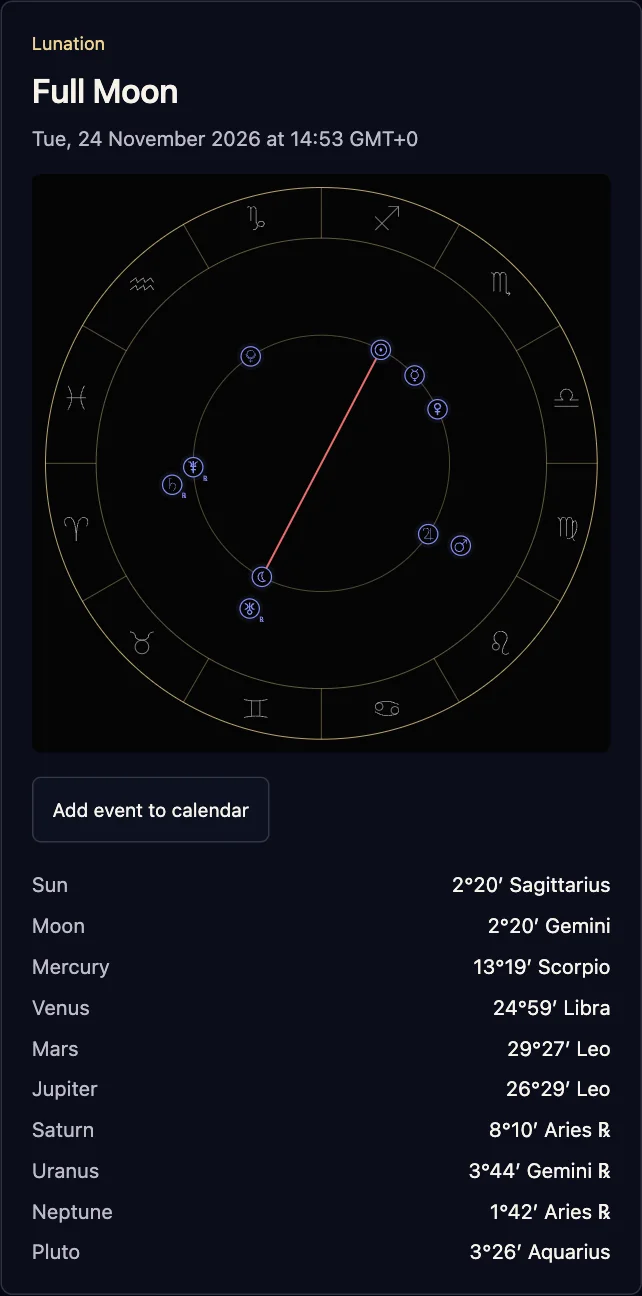
The calendar’s displayed minute comes from its calculation engine. Another ephemeris can give a slightly different time, especially for a slowly changing relationship between outer planets.
Check the time zone before saving a date
That same Full Moon displays at 15:53 in Europe/Belgrade (GMT+1) and 09:53 in America/New_York (GMT−5). The event stays at the same instant. Only the local clock label changes.
An event near midnight can even belong to a different calendar date in another time zone. Before comparing two event lists, check their time-zone settings. Our time-zone and daylight-saving guide explains how local clock readings relate to a shared instant.
For an event you intend to save, choose the zone you use in daily life. If you are teaching people in several locations, include UTC alongside the date so they have a common reference.
Which events matter for your own chart?
The public calendar shows the same geocentric planetary relationships for everyone. Your birth time is not needed to find that Sun–Moon opposition. The event wheel therefore leaves out houses and location-dependent angles.
A personal transit question adds a birth chart. You might want to know whether that Full Moon is close to one of your natal planets. That requires comparing the event’s positions with your natal positions. The guide to live transits explains the reference chart, and the natal chart and transit explorer lets you choose a moment for comparison.
An exact angle is a calculated relationship. What you make of it depends on the astrological approach and context you bring to the chart. The calendar does not tell you that a particular event will cause a personal outcome or make a day universally good or bad.
Follow a few events through the month
For a first look, keep New/Full Moons, sign changes and stations visible. Add major aspects when you want to explore relationships between bodies in more detail. You can turn categories off again to keep the list useful for the question you are asking.
Select an event before saving it. Check its chart, date and time zone. Then download that event or the events matching your filters as an .ics file. The file stores UTC instants, so your calendar app can display them using its own time zone. It is a saved copy rather than an updating subscription.
The free tool calculates on your device and needs no birth details. Our website-tool privacy details explain the calculation and analytics boundaries.
Explore the planetary-events calendar, choose a month and select an event to see its chart.